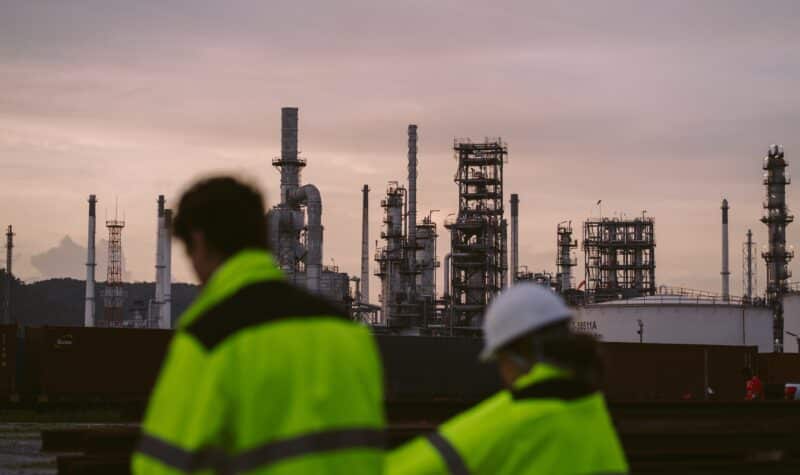
Indonesia’s chemical industry has grown by around 55 per cent since 2016, even as the country’s domestic oil and gas production has declined by a fifth over the same period. The Strait of Hormuz blockade exposed exactly what that divergence means in practice: a fast-growing industry sitting on top of a shrinking domestic resource base, with critical feedstocks sourced heavily from the Gulf.
But the impact of the shock was not felt evenly. And the difference between who was protected and who was exposed tells us a great deal about where Indonesia’s decarbonisation opportunity lies. Below we set out what our research found and what it means for the path ahead.
Different experiences across three distinct value chains
Indonesia’s petrochemical sector operates across three largely disconnected value chains, and the blockade hit each of them differently.
State-owned crude oil refineries run by Pertamina experienced moderate disruption. Price inflation from global crude markets pushed up operational costs, and facilities reliant on Middle Eastern crude faced constraints in switching to alternative supplies, because individual refineries are engineered for specific crude characteristics and cannot easily process off-specification alternatives.
Private naphtha crackers suffered severe distress. Because domestically refined naphtha is directed toward national fuel supply rather than industrial feedstock, private producers import all of their naphtha. When the Strait closed, they were fully exposed. Chandra Asri, Indonesia’s largest private petrochemical producer, declared force majeure on 2 March 2026 and halted production entirely. Lotte Chemical narrowly avoided the same outcome only because it had secured a three-month naphtha stockpile before the conflict began. Domestic plastic resin prices rose by 30 to 80 per cent as a result, hitting food and beverage MSMEs hardest.
State-owned fertiliser producers, by contrast, were almost entirely insulated and some even profited. Pupuk Indonesia draws 100 per cent of its feedstock from domestic gas, supplied at a government-capped price of USD 6 per MMBTU. While global fertiliser prices spiked, Pupuk Indonesia exported its surplus production into those high-price international markets, generating commercial profit margins underpinned by cheap, price-controlled domestic gas.
This asymmetry is the defining feature of Indonesia’s experience. The state’s policy framework is forceful, but it is directed primarily at energy security and consumer protection. Industrial feedstock for private producers falls outside that protection, and the consequences of that gap were fully exposed in March 2026.
Companies are shifting course, policy needs to catch up
The immediate corporate response to the crisis was defensive, focused on securing alternative supplies and stabilising operations. But our research found that something more significant is now underway at an executive level.
The blockade has exposed the structural risk of an industrial model dependent on imported hydrocarbons. As supply chains stabilise, major companies are reassessing long-term strategies and increasingly treating decarbonisation as a mechanism for feedstock security and risk mitigation rather than simply an environmental cost.
This shift is already visible in specific company plans. Chandra Asri is evaluating investment in bio-naphtha production and running pilot projects on plastic waste recycling and chemical recycling. Pupuk Indonesia is developing a green ammonia facility and has completed a pilot co-firing project with green and blue ammonia at coal power plants. Pertamina is investing in bio-based refining, producing hydrotreated vegetable oil and sustainable aviation fuel from domestic palm oil derivatives.
At the national level, President Prabowo’s mandated push for 100 GW of solar power, announced in March 2026 in direct response to the war, signals genuine political will for energy independence. But our research found a consistent gap between this kind of high-level political commitment and the actual allocation of oil, gas, and industrial feedstock in practice. Hydrocarbons continue to be directed toward transportation and household energy rather than industrial feedstock, and binding carbon regulations for the chemical sector have yet to be established.
Decarbonisation is still viewed primarily as a cost by most of the industry. That will not change through environmental advocacy alone. It will change when the policy framework makes low-carbon production commercially viable.
Six opportunities worth acting on now
Our research identifies six strategic interventions that align decarbonisation with Indonesia’s own economic priorities, particularly feedstock security, export competitiveness, and preparation for the EU Carbon Border Adjustment Mechanism (CBAM). The full analysis of each is in the report, including a detailed assessment of how each programme aligns with the interests of industry, government, and civil society.
- Establish a National Industrial LCA and CBAM Readiness Lab: Indonesian exporters face growing exposure to the EU CBAM, which will effectively penalise high-carbon exports to Europe. A centralised database for life cycle assessment of petrochemical products, built with universities and industry, would help Indonesian producers understand and communicate their carbon footprint, protect export revenues, and prevent the kind of deindustrialisation that could follow from being locked out of premium European markets. This intervention directly serves the government’s economic priorities, which makes it one of the most tractable entry points in the current political environment.
- Develop a Green Ammonia Project Preparation Facility: Pupuk Indonesia’s green ammonia ambitions are genuine and strategically significant, but the projects need technical and financial preparation to become bankable. Civil society and philanthropy can play a concrete role here, providing advisory support to help Pupuk Indonesia develop its green ammonia pipeline into projects that can attract international capital. Green ammonia exports, particularly to markets like Japan, Australia and South Korea, represent a significant commercial opportunity, and aligning this with decarbonisation creates shared interest across industry and government.
- Introduce low-carbon plastics certification and procurement standards: Certifying the embedded emissions of plastic products, and embedding low-carbon specifications into government and state enterprise procurement, would create a domestic market for green plastics without placing an immediate and unacceptable cost burden on producers. Our research points to the success of a similar approach in Indonesia’s low-carbon cement sector, where government procurement mandates drove adoption far more effectively than voluntary standards alone. Replicating that model for plastics is a concrete and precedented policy ask.
- Deploy emissions-linked import safeguards: Indonesia’s private plastics producers are already competing against cheaper, large-scale producers in China and the Middle East. Without trade measures that account for carbon intensity, domestic investment in lower-carbon production is commercially unviable. An emissions-linked import safeguard, designed to penalise high-carbon petrochemical and plastic imports, would protect domestic producers from dumping while creating the market conditions in which green investment makes commercial sense.
- Back waste-to-chemical pilot models: Indonesia faces a significant and growing municipal solid waste problem. Formalising supply chains that convert plastic and agricultural waste into chemical feedstock for producers like Pertamina and Chandra Asri would simultaneously address that landfill crisis, reduce naphtha import dependency, and create formal employment for waste collectors. Our analysis suggests this is an intervention with strong alignment across environmental, economic, and social priorities, making it well-suited to a civil society and philanthropy entry point.
- Introduce a bio-naphtha blending mandate: Pertamina already has the technical capacity to produce between 300,000 and 500,000 tonnes of bio-naphtha by modifying its existing hydrotreated vegetable oil and sustainable aviation fuel refining units. A phased blending mandate for bio-naphtha in the chemical sector would reduce naphtha import dependency, saving foreign exchange, and build a domestic supply chain for bio-based feedstocks. Our research identifies this as an intervention that could replicate the logic of Indonesia’s successful biodiesel programme, aligning the interests of domestic producers with a clear national economic objective.
Read the report
Our research covers Indonesia’s petrochemical value chains in detail, including the asymmetric impact of the blockade across state-owned refineries, private naphtha crackers, and state-owned fertiliser producers. We also set out a full analysis of decarbonisation pathways for the fertiliser and olefin sectors, and a detailed assessment of all six strategic programmes, including their alignment with industry, government, and civil society interests.
Related resources