
The European chemicals sector is still strongly dependent on fossil fuels.
As such, it faces a dual challenge. How does it transform itself to align with increasingly ambitious climate, environmental and health goals, while still remaining competitive in a global market?
The industry’s leading narrative is one of a sector in financial decline, unable to invest in a sustainable future and facing regulations that stifle its competitiveness. But the evidence tells a different story.
The chemicals sector can – and should – invest in its future
This latest research, commissioned by Climate Catalyst and undertaken by CE Delft, paints the picture of an industry that is choosing to reduce overall investment whilst increasing payouts to its shareholders.
Rather than falling behind its peers in the US and China, the European chemicals sector had profit margins comparable to other regions between 2016 to 2025. And it was able to pay out some €191 billion to shareholders over the same period – around €83.2 billion more than if the previous decade’s payout ratio had been maintained.
At the same time, investment as a share of assets fell over the same period. Between 2016 to 2025, companies invested the equivalent of just 14.7 per cent of their asset base, while awarding some 53 per cent of their profits back to shareholders.
The future chemicals sector can be both sustainable and competitive
We need to see a European chemicals sector that produces chemicals that fulfill essential functions, and that operates within planetary boundaries. This means non-toxic, fossil-free, circular, just and transparent value chains.
This sector will look different. The research shows it will be smaller upstream, more circular and more decentralised. It will require the sector to be more selective, with circularity substantially reducing the scale of primary chemicals production, while retaining strategically important production that can be sustainably competitive.
The future competitiveness of the sector will require the sector undergo a transformation.
The policy challenge will be identifying those production platforms that are both strategically important for European value chains and credible options for low-carbon and circular production.
Policy recommendations
The report lays out clear priority areas for policymakers to focus.
- Create markets for circular materials and reduce demand for virgin production through material efficiency, reuse and recycled-content requirements
- Develop targeted demand-side policies for sustainable non-fossil feedstocks, subject to robust sustainability criteria
- Make preventing and substituting hazardous substances a core objective of industrial transition policy
- Target public support towards assets and value chains that can form part of a sustainable European industry, rather than preserving existing capacity
- Protect sustainable European production from carbon and environmental leakage through comparable carbon and product requirements for imports
- Develop an integrated European scenario that assesses climate neutrality, fossil feedstock use, circularity and toxicity together
Any questions or for more information on our chemicals work, please contact Nikolas Aguilar or Emma Richardson.
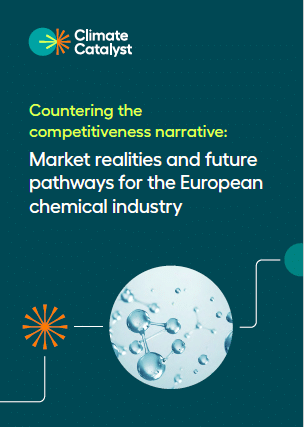
Read more on how the European chemical’s sector can be competitive and sustainable
Our useful executive summary offers a quick overview of the research. Or why not dive into the full research by CE Delft.
Related resources
Subscribe to updates
