Europe is facing an aviation fuel crisis. The Iran conflict has sent jet fuel prices soaring, exposed the structural fragility of a sector still hooked on imported fossil energy, and sharpened the question every investor in aviation and oil and gas now needs to answer: Now that this sector needs to transition much faster than anyone expected, how will the weight of this change be shared across the ecosystem?
Our new briefing sets out the implications for policy, broader markets and more critically for how investors should be acting, now. Because the question is no longer whether the aviation sector will transition, but how quickly it will decarbonise, and which actors are best positioned to capture value from that transition.
The crisis in numbers
$141/barrel
Average jet fuel price for the week ending 29 May 2026, more than double pre-conflict levels
$53bn
Market value lost by global airline carriers in the first month of the conflict
$130bn
Value gained by the “Big Six” oil majors in the first two weeks
The structural problem
The Iran war did not create Europe’s dependence on imported fossil fuels. It exposed it.
Europe’s energy import dependence has grown in recent decades. The aviation sector sits at the sharp end of this vulnerability since its fuel is priced in spot markets, sourced internationally and controlled by an oil and gas industry that profits when prices surge.
Calls to temporarily suspend carbon pricing or weaken alternative fuel mandates in response to the crisis would do little to address the sector’s actual problem. They would instead delay the viable solutions. As the data shows, EU climate policies add less than €10 to the cost of a short-haul flight, whilst fossil fuel volatility adds around €30.
The case for e-kerosene
Not all alternative fuels are equal. Waste-based fuels face scalability limits. In addition to those, biofuels face growing questions around feedstock sustainability as well. E-kerosene, produced from renewable electricity, captured carbon and green hydrogen, is the only drop-in substitute for fossil kerosene that is both scalable and more sustainable, with potential lifecycle emission reductions of up to 98 per cent.
ReFuelEU Aviation and the EU Emissions Trading System are not only important climate instruments, but tools for long-term energy security and the resilience of the sector.
Meeting European fuel mandate targets at the EU and UK levels through domestic e-kerosene production alone could generate an estimated €20 billion in gross value added and 4,000 new jobs.
What this means for investors
The Iran conflict is a stress test. Here is what investors should do next:
- Treat this crisis as a fossil fuel stress test, not a one-off shock. Assess whether companies in the aviation sector and oil and gas are genuinely positioned for a world of declining fossil fuel dominance and recurrent oil shocks. Short-term returns are not the right lens to judge oil and gas companies’ performance.
- Intensify stewardship of oil and gas companies supplying aviation fuels in the EU. Ask direct questions: Do they have a credible plan to meet ReFuelEU obligations? What are their volumetric targets for e-kerosene? Have they quantified the penalties and transition risks of non-delivery?
- Push for fair and transparent access to airport fuel infrastructure. Oil and gas companies own much of the storage pipeline and refuelling assets aviation depends on. Investors should demand these are opened to alternative fuel suppliers on non-discriminatory terms — and that blanket surcharge models are not being used to pass compliance costs onto customers.
- Move oil and gas companies from passive compliance to active participation. Engagement should go beyond meeting mandates. Investors should be asking whether companies are investing in e-kerosene production, forming partnerships with developers, and participating in industrial alliances to accelerate project delivery.
- Use engagement to improve the bankability of e-kerosene supply. Press oil and gas, and aviation investee companies to sign long-term offtake agreements with price and volume commitments. Where companies aren’t yet ready, push for a credible timetable and a clear internal decision-making framework for future participation.
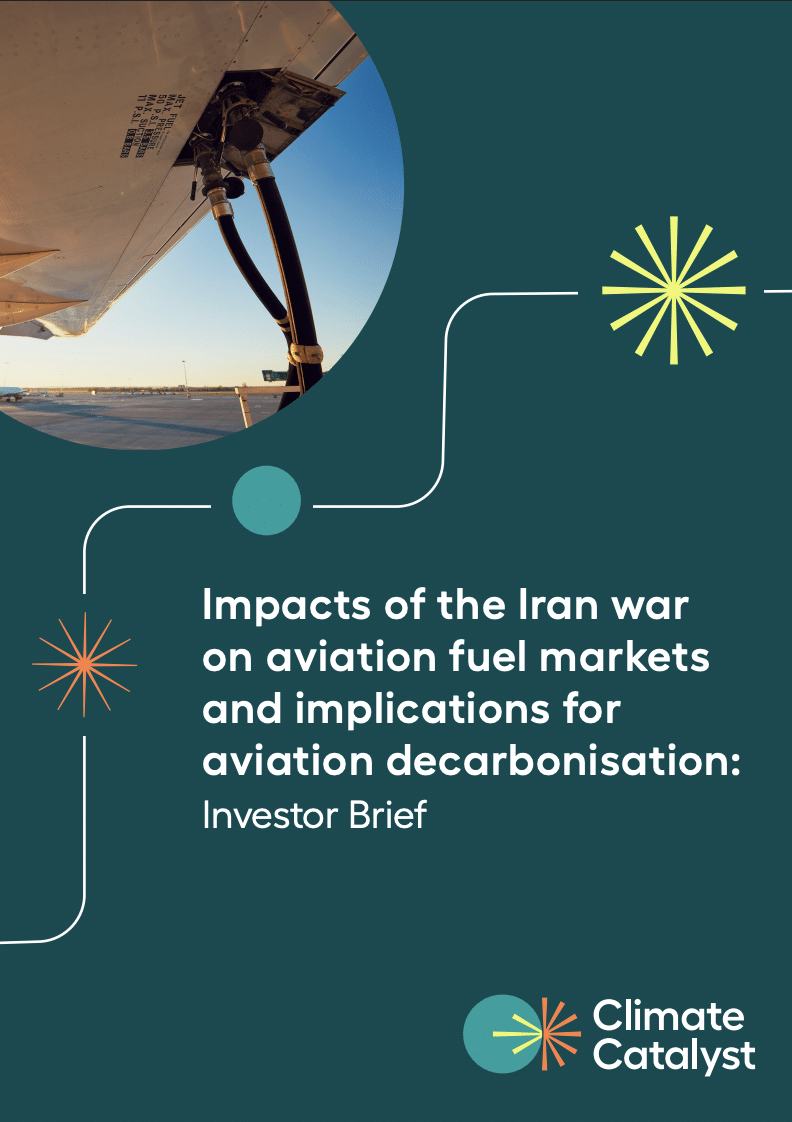
Download the complete investor brief now
Our analysis covers the EU regulatory landscape, the investment implications of the Iran conflict, and six recommendations for how investors should approach stewardship across aviation and oil and gas.