
Steel decarbonisation is not an economic burden for Indonesia – but a huge economic opportunity. New research from Climate Catalyst and Pusat Studi Energi Universitas Gadjah Mada (PSE-UGM), has shown that by accelerating the steel transition, Indonesia could reap benefits such as boosting national GDP, increasing welfare benefits and protecting trade competitiveness.
Indonesia steel: a sector at a cross-roads
Indonesia’s steel sector is at a critical juncture as it navigates operational challenges and market exposure. Currently, steel factories are running at 62 per cent capacity – far short of the 80 per cent needed for the sector to be financially healthy long-term.
While climate policy is often pitted against economic concerns, none of the challenges facing the sector are climate related. Instead, there are three main burdens for steel producers in Indonesia: high dependency on coal imports from a single country, China; high-emission imports also flooding the country due to a lack of domestic carbon rules; and growth in capacity outweighing demand.
This latest research shows that a strong climate policy would not only cut emissions by 30 per cent by 2050, but could also address some of the structural challenges facing the industry. Business-as-usual, meanwhile, could leave the sector more exposed. Continued investment in coal-based production carries potential stranded-asset risks of up to US$35 billion.
SUMMARY
This new research shows that steel decarbonisation is not an economic burden for Indonesia, but a primary economic pathway. An accelerated transition for the sector would resolve existing structural weaknesses, while also expanding national GDP, bringing welfare benefits and protecting trade competitiveness. The economics and the climate case move together.
Share on:
A climate and economic transition
The report models three scenarios: ‘Business-as-Usual’, a ‘Gradual Transition’ , which sees the introduction of a US$25 per tonne carbon price, a 35 per cent green procurement target by 2050 and moderate expansion of electricity-based steel production, and an ‘Accelerated Transition’ which see as US$50 per tonne carbon price, 70 per cent green procurement target by 2050 and a mandate for new facilities from 2027.
The report shows that by transitioning the sector, Indonesia could see:
0.21 to 0.25
per cent growth in GDP
US$28 – 34
billion in welfare gains between 2025-50
US$4.3 – 8.2
billion trade surplus – from a US$405 million deficit
64.1%
rise in secondary steelmaking roles
While the overall job market will grow, the report emphasises that policies will be required to ensure the transition happens in a just manner. Newer green steel plants will require fewer on-site workers than older facilities. More jobs will, instead, be available across the steel supply, including in renewable energy and recycling.
These jobs, however, would likely open up in different locations—away from traditional steel hubs like Cilegon in Banten and Morowali in Central Sulawesi. Proactive government policies will be required to ensure investment in retraining, community support, and fair job placement—ensuring a truly just transition for all.
Harnessing the opportunity
To capture these economic opportunities and build sector resilience, several strategic policy levers could be considered, all of this can be done by amplifying the current legislation:
- Green public procurement: Setting low-carbon steel goals for government construction projects to create steady demand.
- Clear carbon standards: Expanding national quality standards (SNI) to include carbon disclosures.
- Clean energy and scrap supply: Formalising the domestic scrap metal supply chain and making it easier for steelmakers to access reliable, affordable renewable energy.
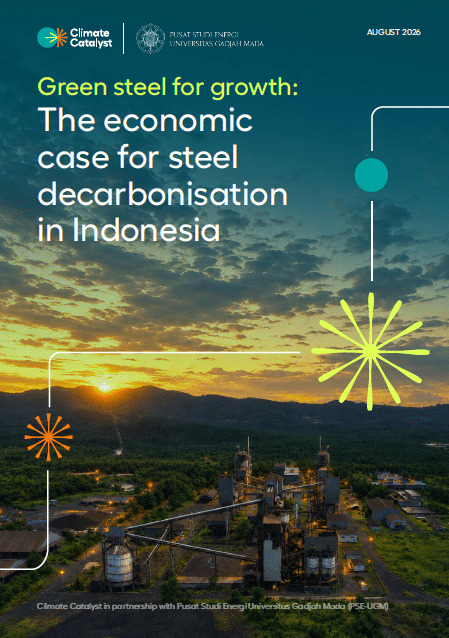
Read more on the economic case for decarbonisation
Explore the full modelling and more on the policy levers that can help harness this economic opportunity. Download the report today
Partners we worked with on this learning

Related resources


Subscribe to updates
